Introduction
One of the biggest challenges faced by businesses in India is delayed payments from customers. Many companies offer credit periods of 30, 60, or even 90 days to clients, especially in B2B transactions. While sales may look strong on paper, delayed receivables often create severe cash flow pressure.
This is where invoice discounting becomes a practical financing solution.
Invoice discounting helps businesses unlock cash tied up in unpaid invoices without waiting for customers to pay. It improves liquidity, supports daily operations, and helps companies grow without taking traditional long-term debt.
In this article, we will explain how invoice discounting works, its benefits, eligibility, risks, and how Indian businesses can use it smartly to improve working capital management.
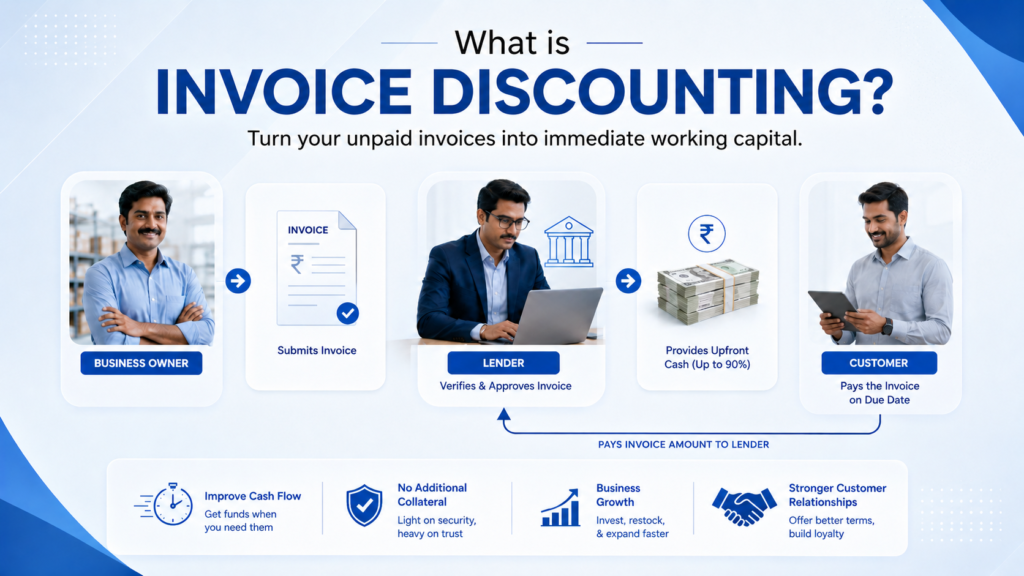
What is Invoice Discounting?
Invoice discounting is a short-term financing method where businesses borrow money against their unpaid customer invoices.
Instead of waiting 30–90 days for customer payments, businesses receive an advance from a bank, NBFC, or fintech lender against those invoices.
Once the customer pays the invoice, the remaining amount is settled after deducting financing charges.
Simple Example
Suppose your company has issued an invoice of ₹10 lakh payable after 60 days.
With invoice discounting:
- A lender may provide 80%–90% of the invoice amount immediately
- You receive around ₹8–9 lakh upfront
- Once the customer pays after 60 days, the lender deducts charges and releases the balance
This helps businesses maintain smooth cash flow without disturbing operations.
How Invoice Discounting Works Step-by-Step Process
Step | Process |
|---|
1 | Business raises invoice to customer |
2 | Invoice submitted to lender |
3 | Lender verifies invoice and customer credibility |
4 | Advance amount is disbursed |
5 | Customer pays invoice on due date |
6 | Remaining amount settled after charges |
Why Cash Flow is More Important Than Profit
Many profitable businesses still face financial stress due to poor cash flow.
A company may:
-
Have strong sales
-
Show profits in financial statements
-
Own valuable inventory
But if customer payments are delayed, the business may struggle to:
-
Pay salaries
-
Purchase raw materials
-
Pay GST liabilities
-
Meet EMI obligations
-
Accept new orders
Invoice discounting converts locked receivables into immediate working capital.
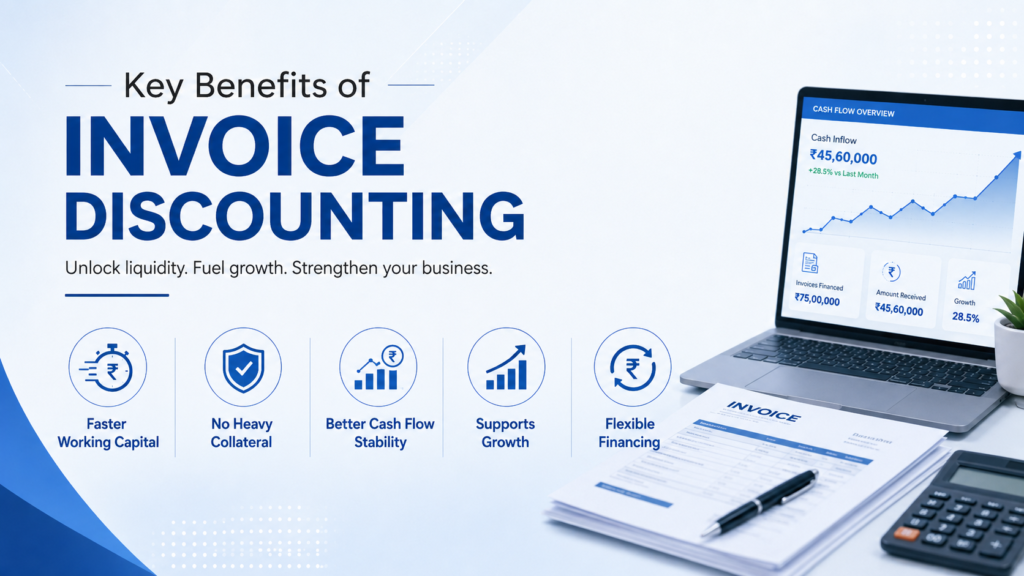
Key Benefits of Invoice Discounting
1. Faster Access to Working Capital
Businesses receive funds quickly without waiting for customer payments.
This improves:
-
Operational efficiency
-
Vendor payments
-
Inventory purchasing
-
Salary management
2. No Need for Heavy Collateral
Unlike traditional business loans, invoice discounting is primarily based on:
-
Invoice value
-
Customer creditworthiness
-
Business turnover
In many cases, no property collateral is required.
This is especially useful for:
-
MSMEs
-
Startups
-
Manufacturing businesses
-
Service providers
3. Improves Cash Flow Stability
Businesses can manage seasonal fluctuations and payment delays smoothly.
Consistent cash flow helps companies:
-
Avoid payment defaults
-
Maintain supplier relationships
-
Negotiate better bulk purchase discounts
4. Supports Business Growth
Companies often lose growth opportunities because funds are stuck in receivables.
Invoice discounting helps businesses:
-
Accept larger orders
-
Expand operations
-
Increase production capacity
-
Improve customer servicing
5. Flexible Financing Option
This makes it:
-
Flexible
-
Scalable
-
Suitable for growing businesses
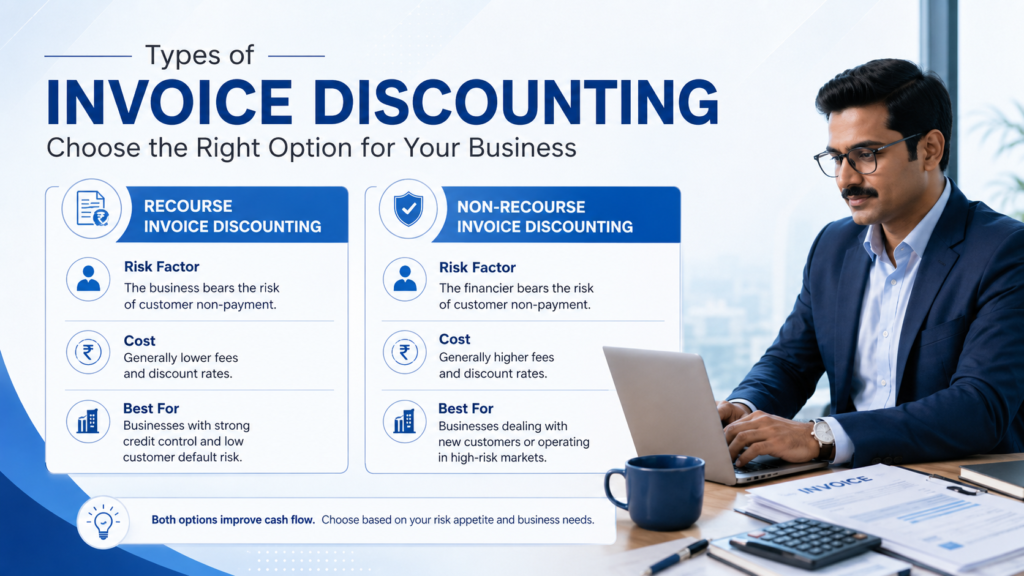
Types of Invoice Discounting
1. Recourse Invoice Discounting
If the customer fails to pay, the business remains liable to repay the lender.
This is the most common structure in India.
2. Non-Recourse Invoice Discounting
The lender bears the default risk if the customer fails to pay.
However:
-
Charges are higher
-
Customer quality requirements are stricter
Invoice Discounting vs Factoring
Many people confuse invoice discounting with factoring.
Here’s the difference:
Feature | Invoice Discounting | Factoring |
|---|---|---|
Customer Interaction | Customer may not know | Factor usually handles collections |
Control of Receivables | Business retains control | Factor manages receivables |
Confidentiality | Mostly confidential | Less confidential |
Suitable For | Established businesses | Businesses needing collection support |
Who Can Benefit from Invoice Discounting?
Invoice discounting works best for businesses that:
-
Sell on credit terms
-
Have regular B2B invoices
-
Work with reputed companies
-
Face delayed payments
-
Need short-term liquidity
Industries Commonly Using Invoice Discounting
-
Manufacturing
-
Traders & wholesalers
-
Logistics companies
-
IT & software services
-
Pharma distributors
-
Construction suppliers
-
Export businesses
Eligibility Criteria for Invoice Discounting in India
Different banks and NBFCs have different criteria, but common requirements include:
Business Requirements
-
Minimum operational history of 1–3 years
-
Regular business turnover
-
GST registration
-
Stable banking transactions
Customer Requirements
-
Reputed corporate buyers
-
Good payment track record
-
Creditworthy companies
Financial Requirements
-
Healthy receivable cycle
-
Acceptable CIBIL score
-
Proper audited financials
Documents Required
Generally required documents include:
-
GST returns
-
Bank statements
-
KYC documents
-
PAN card
-
Business registration proof
-
Audited financial statements
-
Sales invoices
-
Purchase orders
Role of TReDS Platform in India
The RBI introduced the TReDS (Trade Receivables Discounting System) platform to help MSMEs access invoice financing efficiently.
Popular TReDS platforms include:
-
RXIL
-
M1xchange
-
Invoicemart
Benefits include:
-
Digital processing
-
Competitive financing rates
-
Faster disbursals
-
Transparent bidding by financiers
Large corporates registered on TReDS help MSMEs receive quicker funding against approved invoices.
Invoice Discounting for MSMEs
MSMEs often face delayed payments from large corporates.
Invoice discounting helps MSMEs:
-
Reduce dependence on unsecured loans
-
Improve liquidity
-
Maintain production cycles
-
Reduce borrowing costs
Under various RBI and MSME initiatives, invoice financing adoption is growing rapidly in India.
GST and Tax Considerations
Businesses should consider the following:
GST Implications
-
GST is applicable on service charges charged by financiers
-
GST on invoice value remains payable as per normal invoicing rules
Income Tax Treatment
-
Financing charges are generally treated as business expenses
-
Proper accounting entries should be maintained
Consult your CA or financial advisor for accurate tax treatment.
Risks of Invoice Discounting
While invoice discounting offers several benefits, businesses should also understand associated risks.
1. Cost of Financing
Frequent invoice discounting may increase financing costs over time.
2. Customer Default Risk
If customers delay or default, businesses may remain liable under recourse arrangements.
3. Overdependence on Short-Term Funding
Businesses should avoid excessive dependence and improve overall receivable management.
Tips to Use Invoice Discounting Smartly Choose Creditworthy Customers
The stronger your customers, the easier and cheaper financing becomes.
Monitor Receivable Cycles
Track:
-
Outstanding invoices
-
Average collection period
-
Delayed customers
Compare Multiple Lenders
Banks, NBFCs, and fintech platforms offer different rates and structures.
Compare:
-
Interest rates
-
Processing fees
-
Advance percentage
-
Turnaround time
Use It Strategically
Use invoice discounting primarily for:
-
Working capital gaps
-
Temporary liquidity support
-
Business expansion opportunities
Avoid using it for unnecessary spending.
Real-World Example
A manufacturing company in Punjab supplies industrial products to large corporates with 75-day payment terms.
Due to delayed receivables:
-
Raw material purchases were slowing down
-
Supplier payments were delayed
-
New orders were difficult to fulfill
The company started invoice discounting through an NBFC.
Results:
-
Received 85% invoice value upfront
-
Improved production cycle
-
Increased monthly turnover
-
Reduced supplier payment delays
This improved overall business stability without taking heavy long-term loans.
Key Takeaways
-
Invoice discounting helps businesses unlock funds stuck in unpaid invoices
-
It improves working capital and cash flow management
-
MSMEs and B2B businesses benefit significantly
-
It is faster and more flexible than many traditional loans
-
TReDS platforms are making invoice financing more accessible in India
Conclusion
Cash flow problems can affect even profitable businesses. Delayed customer payments should not stop business growth or operational stability.
Invoice discounting offers a practical solution by converting receivables into immediate working capital. When used strategically, it can improve liquidity, support expansion, and strengthen overall financial management.
Businesses should evaluate financing costs, customer quality, and lender terms carefully before choosing invoice discounting solutions.
If you are looking for expert guidance on invoice discounting, working capital loans, or business finance solutions, AskMeFinance can help you find the right funding structure for your business needs.
Frequently Asked Questions (FAQs)
1. Is invoice discounting a loan?
Technically, it is a short-term financing facility against unpaid invoices rather than a traditional term loan.
2. Does invoice discounting require collateral?
In many cases, no heavy collateral is required because financing is backed by invoices and customer receivables.
3. Who can apply for invoice discounting?
MSMEs, manufacturers, traders, service providers, exporters, and B2B businesses with valid invoices can apply.
4. What is the difference between invoice discounting and factoring?
Invoice discounting allows businesses to retain control of receivables, while factoring usually involves third-party collection management.
5. Is invoice discounting available through banks?
Yes. Banks, NBFCs, fintech lenders, and TReDS platforms provide invoice discounting services in India.
6. How quickly can funds be received?
Depending on the lender and documentation, disbursal can happen within 24–72 hours.
Contact Us
Let's Get Your
Loan Sanctioned
Reach Us Directly
📞
+91-1762-539345
Call for instant loan consultation
✉️
🏢
Registered Office
504, 5th Floor, Tricity Trade Tower,
Near Radisson Hotel, Chandigarh-Patiala Highway,
Zirakpur (Mohali) – 140603
Near Radisson Hotel, Chandigarh-Patiala Highway,
Zirakpur (Mohali) – 140603
📍
Branch Offices
Zirakpur ·Patiala· Amritsar
🌐
Also Serving
Chandigarh · Delhi · Mumbai · Ludhiana
Get a Free Consultation